
Apostille for Dominican documents: who issues it and where
The Dominican apostille is not issued at the consulate. The only competent authority is the Ministry of Foreign Affairs in Santo Domingo.
Since when
The Dominican Republic acceded to the 1961 Hague Convention on 12 December 2008, and it entered into force for the country on 30 August 2009. Before that date the route was chain consular legalization.
Never miss a change to your consular procedures
Receive notifications about mobile consulates, changes to procedures (passport, visa, registration), costs, appointments, and key election dates. No spam, unsubscribe anytime.
The detail almost nobody publishes
An apostilled Dominican document is recognized by every signatory State except Austria, Belgium and Germany, which objected to the Dominican Republic's accession to the convention.
For the United States the apostille works without trouble, which is what matters here. But if the document is going to Germany, Austria or Belgium, an apostille is not enough and you have to ask that country's representation.
| Item | Detail |
|---|---|
| Authority | Foreign Ministry, Santo Domingo |
| In force since | 30 Aug 2009 |
| Not recognized by | Austria, Belgium and Germany |
What gets apostilled and what gets legalized
A Dominican public document heading for another convention State gets apostilled. What Dominican consular officers themselves produce abroad gets legalized instead.
Two different stamps from two different authorities, and mixing them up costs a journey.
US documents for the Dominican Republic
The route is the mirror image: the Secretary of State of the issuing state apostilles them. The Dominican consulate plays no part in that.
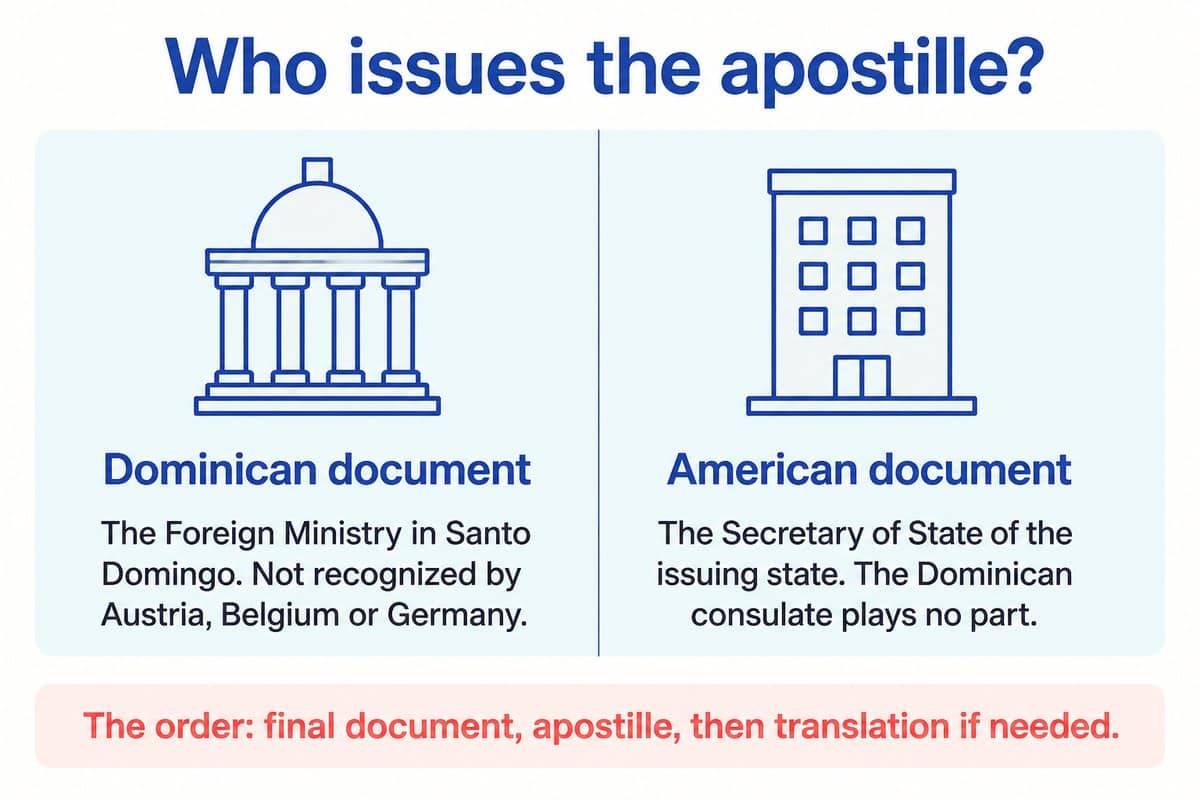
And mind the order: the long-form document first, then the apostille, and only then the translation if one is needed.
What the consulate does do
Legalize signatures on private documents, translate, and certify copies. Each of those has its own guide.
Which documents get apostilled
Public documents: civil registry records, court rulings, official academic certificates, police clearance and notarial documents that have already been through the right circuit.
A private document, a contract between individuals or a letter, is not apostilled as it stands: the signature has to be legalized before a notary first, and then that notarial act gets apostilled.
What it actually certifies
An apostille says nothing about the content of the document. It certifies origin only: that the signature is genuine, that the signer acted in the capacity stated, and that the seal or stamp is the right one.
That matters because people sometimes request one believing it validates what the paper claims. It does not.
The order you cannot change
The document in its final form first. Then the apostille. Then the translation, if the destination country wants one.
Translating before apostilling almost always means paying for the translation twice, because the apostille is added to the document and has to be translated too.
If you cannot travel to Santo Domingo
The practical route is granting a power of attorney at the consulate so somebody handles it for you on the island. It is one of the commonest uses of consular powers.
The Dominican apostille does not work in Austria, Belgium or Germany.Details verified on 8 September 2026.
This site is an independent directory. consuladosdominicana.us is not the Dominican Embassy or any of its consulates, and it processes no documents.
We gather what the official sources publish and flag it when they disagree. Even so, call before you go: opening hours change overnight.