
Signature legalization and certified copies
The Dominican consulate provides notary services, and two procedures come out of that which people often confuse: signature legalization and certified copies.
Signature legalization
This is the document by which the consular office attests that the signature on a document belongs to the person who signed it. It says nothing about the content: only about the signature.
You need the document carrying the signatures and the signatories' identity documents.
Never miss a change to your consular procedures
Receive notifications about mobile consulates, changes to procedures (passport, visa, registration), costs, appointments, and key election dates. No spam, unsubscribe anytime.
How long it takes
Between ten minutes and two hours, depending on the line that day and the staff available. It is one of the procedures resolved in the same visit.
| Item | Detail |
|---|---|
| Signature legalization | 10 minutes to 2 hours |
| Certified copy | 20 minutes to 2 hours |
| Fee | not published |
Certified copies
This means getting a legalized photocopy of an official Dominican document. Bring both the copy and the physical original, because the consulate checks one against the other.
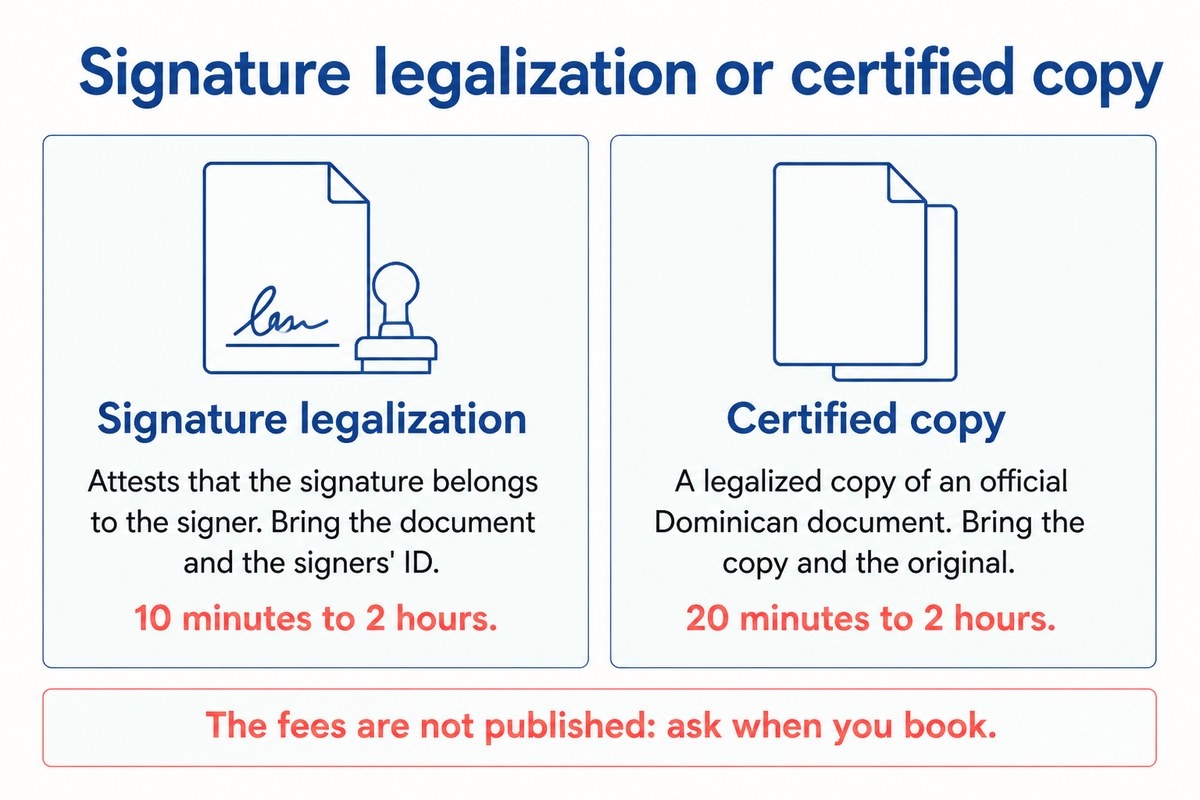
It takes between twenty minutes and two hours.
Translations
The consulate translates official documents in both directions. For US-issued ones it requires them to be official: civil registry records, court rulings certified by the county clerk, transcripts and diplomas signed and sealed by the educational institution.
For Dominican documents the unaltered original is usually enough, and for civil registry records they almost always ask for the acta inextensa.
What it costs
This has to be said plainly: the fees are not published. The official pages for these services write «the fee is:» and leave the number blank. Ask the price when you book, and do not trust the figures circulating on forums.
And what this is not
The apostille is a different thing, issued by the Ministry of Foreign Affairs in Santo Domingo, not by the consulate.
The full route a document takes
Worth seeing whole, to avoid repeat trips. An American document heading for the Dominican Republic goes: long-form original, apostille from the Secretary of State, then translation if required.
A Dominican document used here runs the other way: original from the Central Electoral Board, apostille from the Foreign Ministry in Santo Domingo, then translation.
And whatever the consulate itself produces, a power of attorney or a sworn declaration, gets legalized at the Foreign Ministry rather than apostilled.
Which American documents they accept
They have to be official and signed and sealed by whoever issues them.
Among the most requested: birth and death certificates from the Health Department, marriage certificates certified by the City Clerk, divorce or name-change rulings certified by the County Clerk, and academic transcripts bearing the institution's seal.
Dominican documents
The unaltered original is enough. For civil registry records they almost always require the acta inextensa, the complete version rather than the extract.
A warning about copies
For a certified copy you have to bring the physical original as well as the photocopy. The consulate checks one against the other, so sending only the copy does not work even when it is perfectly legible.
Fees for these services are not published: ask when you book.Details verified on 8 September 2026.
This directory is run privately. consuladosdominicana.us does not belong to the Dominican Government or to any of its consular offices.
We publish what the official sources say and point out where they disagree. Before traveling, check the detail with the office.