
Death certificate and repatriation of remains
When a Dominican citizen dies in the United States there are two separate matters, usually handled together: declaring the death to the consulate and, if the family decides, repatriating the remains.
The declaration of death
This is the act by which the consular office is informed that a Dominican citizen has died. It puts the death on the Dominican civil registry, whatever country it happened in.
Any citizen, Dominican or foreign, or a properly represented institution can make it. You do not have to be next of kin.
Never miss a change to your consular procedures
Receive notifications about mobile consulates, changes to procedures (passport, visa, registration), costs, appointments, and key election dates. No spam, unsubscribe anytime.
What is needed
That the deceased was Dominican, and that someone attends the consular office to make the declaration. They ask for the deceased's cédula if there was one, along with the American death certificate.
Why it is worth doing
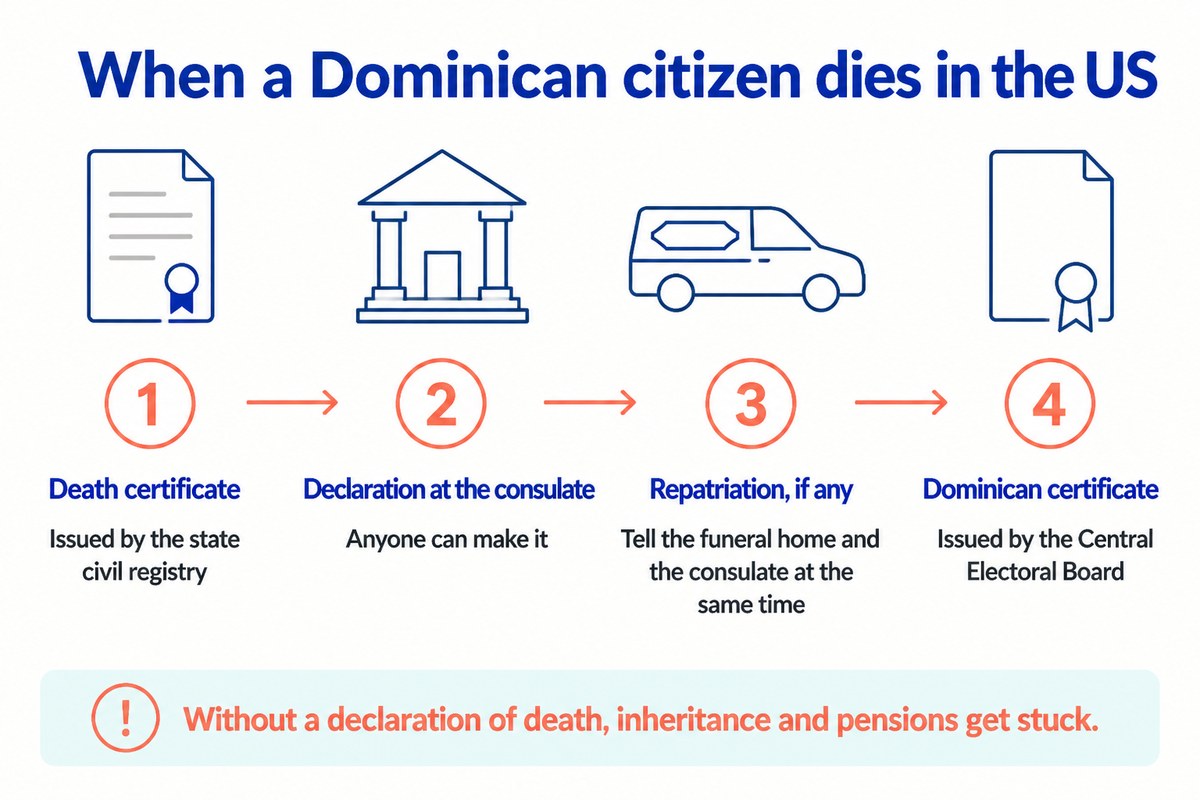
Because without it the death is not recorded in the Dominican Republic, and that blocks inheritance, pensions and anything else that turns on civil status.
Repatriation
Moving the remains to the Dominican Republic is coordinated between the funeral home and the consulate, which issues the consular paperwork the transfer needs. Timings depend on the airline and on the health documentation of the state where the death occurred.
Call the consular office as soon as you have the death certificate: this is the procedure where early warning helps most.
The Dominican certificate
The Dominican death certificate is issued by the Central Electoral Board. What the consulate does is the declaration that leads to that entry.
American documents
A death certificate issued here comes from the state civil registry. If it is going to be used in the Dominican Republic it will need an apostille from the Secretary of State and, depending on the case, a translation.
The order things are best done in
The American death certificate first, issued by the state civil registry. With that in hand you make the consular declaration and, if there is to be a repatriation, you tell the funeral home and the consulate at the same time.
An apostille on the American certificate is only needed if the document will be filed in the Dominican Republic for something later, such as an inheritance.
Inheritance
This is what usually follows. Handling it on the island from the United States nearly always needs a consular power of attorney in favor of somebody there, plus the Dominican death certificate issued by the Central Electoral Board.
That power is signed at the consulate and legalized afterwards at the Foreign Ministry.
Pensions
The death also has to be reported to whichever institution was paying a Dominican pension, where there was one. Without the Dominican certificate no survivor's pension can be processed.
If the deceased had no cédula
The declaration is made anyway. You bring whatever documentation exists, passport or birth certificate, and the consulate advises on how to establish identity in that particular case.
Without a declaration of death, inheritance and pensions get stuck.Details verified on 8 September 2026.
consuladosdominicana.us is a private guide. We do not represent the Dominican State and we take no part in any consular procedure.
The information is reviewed regularly and comes from official sources, which sometimes disagree. Confirm by phone before turning up.