
Registering a child born in the United States
If your child was born in the United States and at least one parent is Dominican, the child is Dominican. What the consulate does is record that birth in the Dominican civil registry.
What the Constitution says
Children of Dominicans born abroad are Dominican, and the registration can begin at consular offices under the conditions current law sets.
Never miss a change to your consular procedures
Receive notifications about mobile consulates, changes to procedures (passport, visa, registration), costs, appointments, and key election dates. No spam, unsubscribe anytime.
The three requirements that surprise people
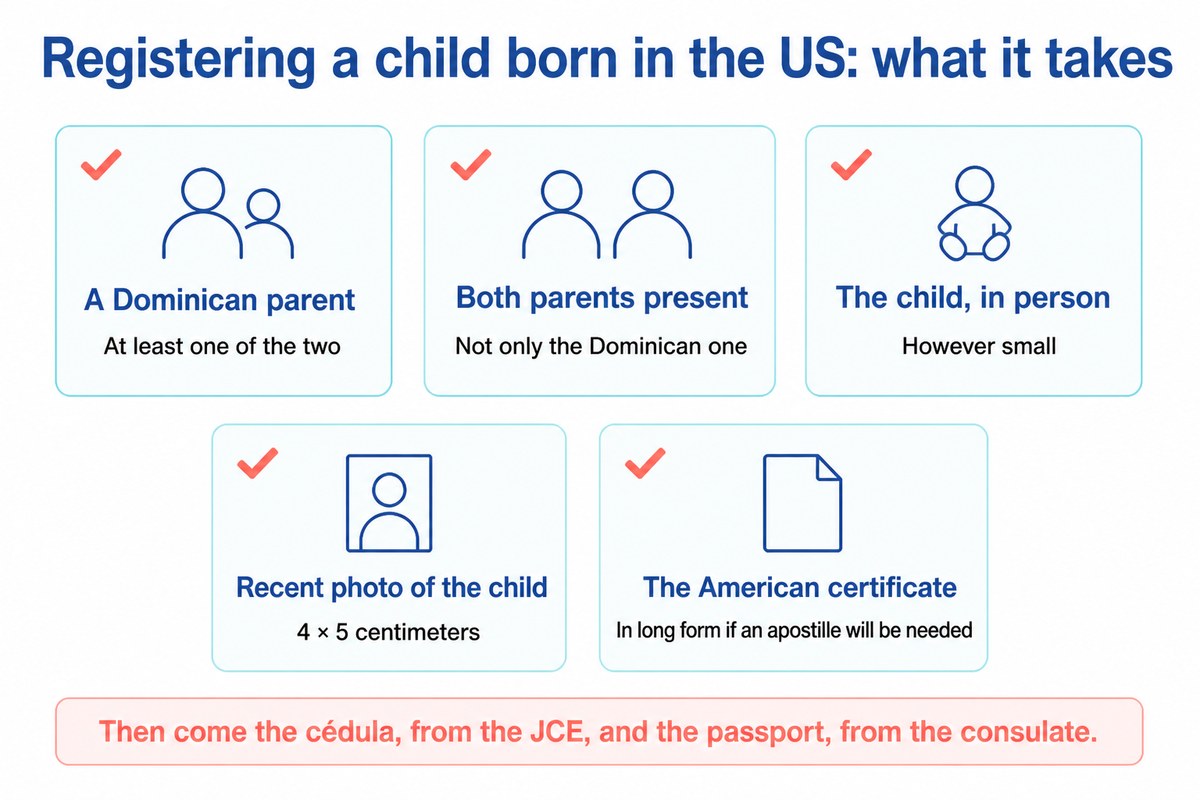
The first is obvious: at least one parent has to be Dominican. The other two are less so.
Both parents have to attend the consular office, not only the Dominican one. And you have to bring the child in person, however small.
They also ask for a recent photograph of the child, 4 × 5 centimetres.
- At least one Dominican parent
- Both parents present at the office
- The child, in person
- A recent 4 × 5 cm photograph of the child
Why doing it early matters
Everything else hangs off this registration: the cédula, the Dominican passport and the right to vote. The longer it is left, the more paperwork it takes, and in some cases late registration kicks in, which is a separate and slower procedure.
The American certificate
Bring the birth certificate from the country where the child was born. If that was one of the five boroughs of New York City, it comes from the Division of Vital Records; and if an apostille will be needed, request it in long form with an exemplification letter.
Registering is not the same as recognizing an adult's citizenship
If the child is already grown and was never registered, the right procedure is Dominican citizenship by descent, which has its own guide and costs 180 dollars.
What if the parents are not married
The registration can still be done. What changes is acknowledgement of paternity: if the Dominican father wants the child to take his surname and acquire nationality through him, he has to attend and acknowledge the child.
That acknowledgement happens in the same act, which is why the consulate asks for both parents.
If one parent cannot attend
This is the commonest question. Ask the consulate before going: in some cases a power of attorney from the absent parent, also drawn up before a Dominican consul, is accepted, but it is not automatic and it depends on the case.
Turning up without that power and without the other parent means losing the appointment.
Late registration
Once the deadlines pass, registration stops being an ordinary procedure and becomes a late birth registration, with more requirements and, depending on the person's age, a court process in the Dominican Republic.
Which is why it is worth not leaving it: the earlier it is done, the simpler it is.
What comes next
With the birth registered, the child can obtain the cédula from the Central Electoral Board and the Dominican passport from the consulate. That is the order, and there are no shortcuts.
You have to bring the child in person, however small.Details verified on 8 September 2026.
consuladosdominicana.us is an independent guide to the Dominican Republic's consular offices in the United States. We are not the Embassy, any Consulate General, or any government body.
We do not book appointments and we do not sell them. Details are checked regularly and can change without notice: confirm with the office before you travel.